

What is it about the circles of standing stones that dot the landscape of Great Britain, Ireland and beyond?
A Guest Post by the Incomparable Catherine Cavendish
Most famous has to be Stonehenge and, yes, it’s magnificent and if you’re lucky enough to actually walk among the stones themselves, you get a feeling akin to being in a cathedral. The massive stones tower above you and create their own unique atmosphere. I know that when I went there, it felt as if something was drawing me back to the past. Sad to say, corralled behind the barrier where most tourists are forced to remain, you simply don’t absorb any of that atmosphere. It’s still worth visiting, though.
But a few miles away, still in wondrously historic Wiltshire, lies the village of Avebury, which simply wouldn’t exist without its stone circles. Yes, plural. There are three of them, and Avebury is the largest complex of its kind in Europe – not only lying within a much larger site, which includes the ancient burial site of West Kennet and the mysterious, manmade Silbury Hill. The whole landscape is a World Heritage Site and, taken together, represents ceremonial and burial sites dating between around 3700 and 1600 BCE. As a result, Avebury is even more important and significant (and older) than Stonehenge.

Not only that, you can wander at will (but, please, with respect) around the stones. It doesn’t take long before you realise that the megaliths, although unworked, have distinct forms, some are lozenge-shaped and others – well, they’re not. Some theorists say they represent male and female, but who knows? That’s the enigma of prehistory. No one wrote anything down. No one is alive today to tell us different, so if we want to claim that aliens landed and caused them to be built, who can disprove it? Not that I am claiming that!
I have wandered among these stones more times than I can even remember and they still draw me back. I can’t explain why. Of course, the sheer mystery surrounding them is compulsive. I mean, look at them, they’re massive. It takes huge amounts of effort to lift and manoeuvre them, even now with our modern equipment. Imagine trying to transport these from miles away, dig pits, upend them, secure them… and to do all of this with tools consisting of antlers and sheer brute force and teamwork from hundreds of your friends and neighbours. And why would you do it anyway? It must have been critically important to them and have been something that was equally significant to the people living many miles away who came to help with their construction and then made regular visits back – for reasons we can only guess at.
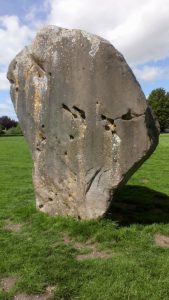
I have a favourite stone. It is known as the Barber Stone for reasons that will become all too clear, since it has some relatively recent history attached to it. When Alexander Keiller and his team excavated the stones back in the 1930s, they lifted this one, which, along with many others, had been felled and buried back in medieval times when the stones were considered evil. Lying underneath the massive stone were the remains of a man whose possessions indicated he was probably an itinerant barber surgeon, who’d made his living by either cutting your hair, shaving your beard or pulling that infected tooth (among other things). It was long believed he had taken on extra labouring duties – maybe to supplement his income or on a voluntary basis to help the cause – and that this led to his demise when the stone toppled, crushing him to death. However, recent evidence points to him already being dead before being placed in a hole that had been prepared for the stone’s burial. There he lay until his discovery. He was taken to London and was thought to have been blown up and destroyed in the Blitz but in 1998, he was discovered in the Natural History Museum, where he now lies at rest. Or does he? I don’t know of any reports of him haunting the area, but other spirits certainly roam there.
“There are so many ghosts in Avebury they probably outnumber the living.”
In fact, there are so many ghosts in Avebury they probably outnumber the living. As far as the stones themselves are concerned, people have reported hearing ghostly singing and strange accidents have occurred there (quite apart from the hapless barber surgeon). Someone in the early part of the twentieth century even reported a timeslip where she witnessed a medieval fayre. Add to those accounts strange, unexplained lights and a general air of ill luck, and Avebury’s stone circles make for a place of great paranormal interest.

I personally can’t report anything untoward, beyond a general atmosphere of time standing still, especially on nocturnal visits. The Barber Stone draws me back time and again and I love to touch its ancient, pock-marked surface. It brings me peace to lean against it and close my eyes. Some people have felt a surge of energy from contact with the stones. Sadly, I cannot corroborate that, but I live in hope.
Next to the Barber Stone is another – this time lozenge-shaped – stone which, when viewed from a certain angle, looks uncannily like a hooded monk. On occasions, this one has engendered an odd, somewhat disquieting feeling in me. Naturally, I have dismissed that as pure imagination but…well, it is a bit spooky.
I often stand, awestruck by the sheer enormity of the task that was Avebury and, like so many thousands of others, wonder what it must have been like to witness the building of his incredible landmark. What were the true motivations to undertake such a mammoth project? Who were these prehistoric engineers and architects? Was it a labour of love or forced labour that erected these monuments? And what, honestly, were they all designed for?
If you want to learn more about Avebury, there is a wealth of information already, and history is being revised all the time, as archaeologists discover more and technology enables them to decipher and decode the hitherto impenetrable mysteries of prehistory. Here’s a good starting point https://www.avebury-web.co.uk/index.html
Avebury has provided me with a wealth of inspiration, including the backdrop for my latest novel:

‘Fear her now, fear the queen,
As in her stone she reigns supreme…’
When Jonathan agrees to accompany his girlfriend, Nadia, on a trip to Landane, he imagines a short relaxing break in the countryside. But he quickly discovers that Nadia isn’t just drawn to the ancient Neolithic stone circle, she is obsessed by the megaliths. One in particular. Within hours, her personality begins to change and it isn’t long before Jonathan starts to fear for her sanity.
Reaching far back into the past and up to the present day, those same stones have demonstrated powers beyond reason and, as Jonathan’s girlfriend becomes increasingly distant from reality, some of the ghosts of the past begin to reappear. Now it isn’t only Nadia who is in danger.
What is the secret of the prehistoric standing stones of Landane? What lies within them? And why does an ancient piece of folklore ring so true?
Available now at:
and/or wherever you shop for books
About The Author
 Following a varied career in sales, advertising and career guidance, Catherine Cavendish is the author of a number of supernatural, ghostly and Gothic horror novels, novellas and short stories.
Her novels include: The Stones of Landane, Those Who Dwell in Mordenhyrst Hall, The After-Death of Caroline Rand, Nemesis of the Gods Trilogy, Dark Observation, In Darkness, Shadows Breathe, The Garden of Bewitchment. The Haunting of Henderson Close, The Devil’s Serenade, The Pendle Curse and Saving Grace Devine.
The Crow Witch and Other Conjurings is a collection of her previously published and brand-new short stories.
Her novellas include: The Darkest Veil, Linden Manor, Cold Revenge, Miss Abigail’s Room, The Demons of Cambian Street, Dark Avenging Angel, The Devil Inside Her, and The Second Wife
She lives by the sea in Southport, England with her long-suffering husband, and a black cat called Serafina who has never forgotten that her species used to be worshipped in ancient Egypt. She sees no reason why that practice should not continue.
You can connect with Cat here:
X/Twitter
Image credits:
Flame Tree Press
Shutterstock
Avebury-web
Have you ever visited Avebury or Stonehenge? Do stone circles and other mysterious places beckon to you? What’s your favourite ghost story?
Thank you so much for hosting me today, JH!
Always a pleasure, Cat! You’re welcome any time. Best of luck with the new release!
Been to Stonehenge twice (second time – so commercial and too busy) but I missed seeing the stones in Avebury.
Hi Alex. I agree with you about Stonehenge. Avebury is much more relaxed and you can wander at will without feeling herded as you do at Stonehenge so you can ask up the atmosphere. Well worth the trip – and The Red Lion does an excellent lunch!
Thanks for commenting, Alex! So good to “see” you again.
Awesome! My daughter was living there for 9 months while serving a mission and we wanted to go see it…but circumstances prevented it. *sigh* This is life, eh? Guess we just get to live it through books/pictures & videos for now?
OMG, Crystal, how are you?! It’s been forever. Welcome back!
I was supposed to see them too–had a whole trip planned and paid for, and then the pandemic struck. This is life, indeed. Hopefully we’ll both get to see them in real life!